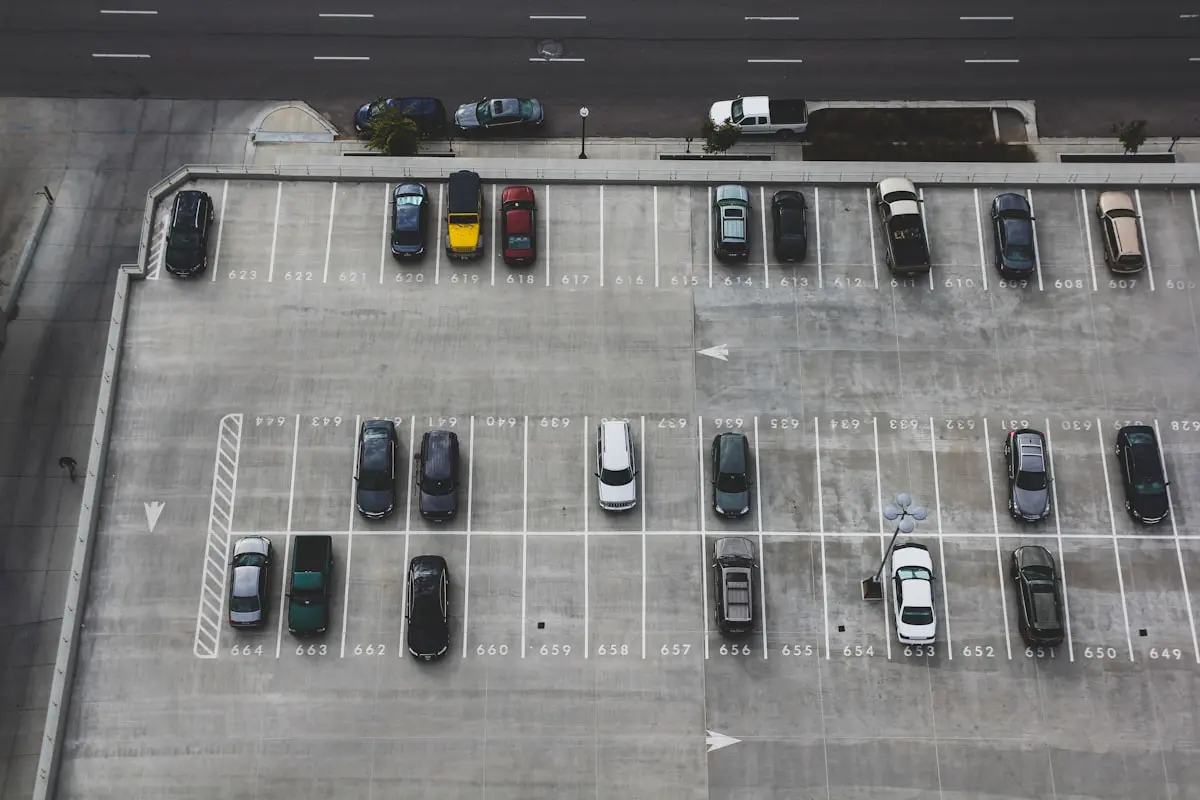
When people think about industries ripe for automation, they think logistics, finance, healthcare. Parking rarely makes the list. It shouldn't be surprising - parking is invisible infrastructure, the kind of business that works when nobody notices it.
But parking operations - particularly airport parking with transfer services - contain nearly every challenge that autonomous systems need to solve. Real-time scheduling, dynamic resource allocation, external data dependencies, customer communication, exception handling under time pressure. It's a compressed laboratory for operational autonomy.
The Complexity Nobody Sees
Airport parking with shuttle transfers involves coordinating multiple real-time systems simultaneously. A customer books parking for a 6 AM flight. The system needs to allocate a parking space, schedule a shuttle pickup at the right time (accounting for the drive from the lot to the terminal and the airline's check-in requirements), track the customer's actual arrival, adjust if they're early or late, and coordinate the return transfer when they land - which might be delayed, diverted, or cancelled.
Multiply this by hundreds of customers per day, add weather disruptions, driver availability, vehicle maintenance, and seasonal demand fluctuation, and you have an operations problem that would challenge any domain.
Most parking operators manage this with spreadsheets, walkie-talkies, and experienced dispatchers who hold the entire operation in their heads. It works - until it doesn't. A sick dispatcher, a flight schedule change, or a demand spike can cascade through the entire operation.
Flight-Linked Intelligence
The most interesting automation opportunity is flight-linked timing. Every customer's schedule is determined by their flight, and flight data is available in real-time via APIs.
An intelligent system monitors every customer's flight status continuously. When a flight is delayed, the system automatically adjusts the return transfer time, notifies the driver, and - if needed - reallocates the driver to another pickup during the gap. When a flight is cancelled, the system initiates the exception workflow: extend the parking booking, notify the customer, adjust downstream schedules.
This isn't possible with manual dispatch. A human dispatcher tracking 200 flights simultaneously, catching delays as they happen, and reoptimizing the schedule in real-time - that's not a realistic expectation. But it's exactly what a system can do.
The most interesting automation opportunity is flight-linked timing.
Voice as an Interface
Parking operations have a natural voice interface requirement. Customers call to make bookings, ask about their pickup time, report that they've arrived, or request changes. Drivers need dispatch instructions. The office needs to handle exceptions.
This makes parking an ideal proving ground for AI voice agents - not the "press 1 for sales" kind, but genuine conversational agents that understand context, access real-time system state, and take actions. A customer calls and says "I just landed at gate 12" - the voice agent identifies them, checks their booking, dispatches the next available shuttle, and confirms the estimated pickup time. No hold queue, no transfer, no human involved.
The combination of structured operations data and natural language interaction makes parking one of the most complete automation challenges: you need the backend systems AND the customer-facing intelligence.
Why It Generalizes
Every pattern in parking automation applies elsewhere. Flight-linked scheduling generalizes to any external-event-driven operation. Real-time dispatch generalizes to any resource allocation problem. Voice agents generalize to any customer-facing operation.
We use parking as a proving ground because it's contained enough to build complete solutions but complex enough to stress-test every component. A system that can autonomously manage airport parking transfers can, with domain adaptation, manage field service dispatch, logistics coordination, or healthcare appointment flows.
The unsexy industries - parking, logistics, facilities management - are where autonomous systems prove themselves. The constraints are real, the exceptions are constant, and there's no room for systems that only work in demos. If it works in parking, it works.
Related

Why Copilots Miss the Point
Copilots keep humans doing the wrong work. The goal isn't better tools for manual tasks - it's eliminating the manual tasks entirely.

Anatomy of an Autonomous Operation
What it actually means for a system to operate autonomously. Decision loops, exception handling, state management, self-correction.
Building something that should run itself?
Start Building